
By Kamal Bell
We are living through a defining moment. The world feels unstable socially, economically, and environmentally yet most public conversations remain stuck on critique. We talk about what’s broken, but rarely about how to rebuild.
That observation raises an internal question for me. Do we possess the appetite for change?
This essay is the first in a four-part series, Appetite for Change, that examines the systems shaping our survival and what it would mean to reclaim them. We begin with one of the most misunderstood yet politically significant programs in America: the Supplemental Nutrition Assistance Program, or SNAP.
SNAP is often reduced in public conversation to “food stamps,” but its purpose and history stretch much deeper. According to the U.S. Department of Agriculture, the first Food Stamp Program pilot began in 1939 under Secretary of Agriculture Henry A. Wallace and Administrator Milo Perkins. The first recipient, Mabel McFiggin of Rochester, New York, used orange and blue stamps to purchase groceries.
The program was suspended in 1943, then revived in 1961 under President John F. Kennedy. By 1974, it had expanded nationwide. It was later integrated into the Food and Agriculture Act and eventually folded into the broader Farm Bill, linking food access with agricultural subsidies and federal spending. This history matters because it reveals that food assistance has always been a structural part of the U.S. economy, not just a temporary fix. SNAP isn’t merely about feeding the poor; it’s about stabilizing markets, moving surplus commodities, and supporting consumer spending during downturns.
It’s easy to ask, “Why do we rely on the government to feed us?” But that question might miss the deeper issue. SNAP is not simply a food program, it’s a wage supplement. It exists because millions of workers earn too little to consistently buy food, even while employed. The real dependency, then, isn’t on food stamps; it’s on an economic structure that underpays labor while subsidizing corporations through government spending. Before we can talk about ending reliance on SNAP, we have to ask: Why does so much of the population need SNAP in the first place?
Instead of seeing SNAP as an obstacle to independence, we might view it as a misdirected but powerful resource. The program distributes more than $100 billion annually in food purchasing power. Today, most SNAP dollars end up in corporate chains like Walmart, Kroger, and Amazon – not in local economies. But if communities built the infrastructure to accept and process EBT cards through farmers’ markets, CSAs, food hubs, and co-ops, those same dollars could directly support local growers, small grocers, and regional distributors. That’s not rejection; that’s redirection. It is a way to transform dependency into sovereignty and turn a federal safety net into an engine for local self-determination.
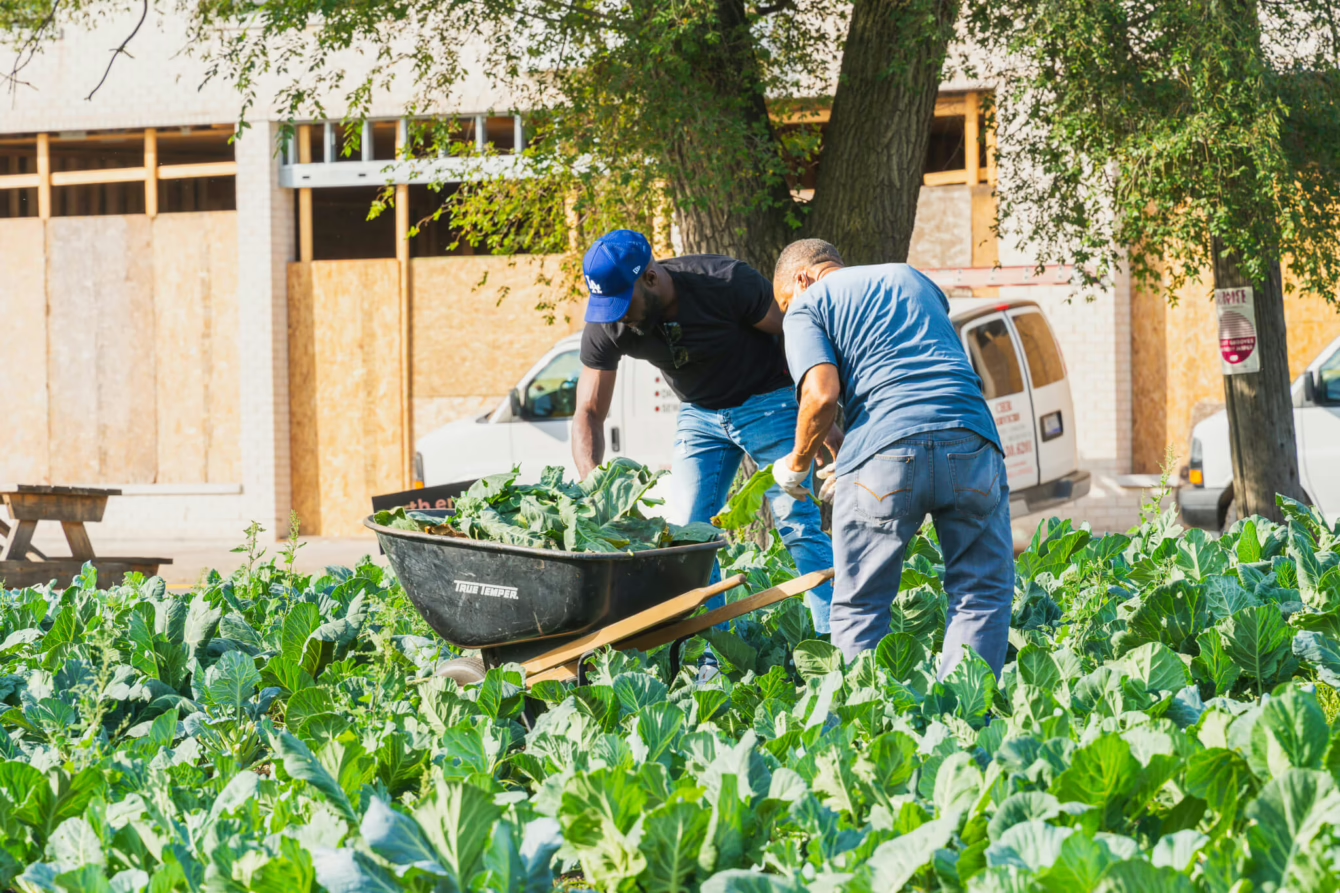
As a society, we’ve also become dangerously detached from how food reaches our tables. Most people have never planted, harvested, or processed the ingredients they eat. Farming, an essential human act, has been made invisible. This disconnection has political consequences. It means we debate food systems abstractly while remaining dependent on them materially. We argue about policy, but very few of us know how to grow, store, or preserve food if that system falters. When food becomes purely political, we lose sight of the fact that eating and having access to food is a moral act. To liberate ourselves from systemic dependence, we must restore that connection to see food production not as charity or hobby, but as civic responsibility.
Reducing dependency on the larger system requires action on multiple fronts. We have to understand how programs like SNAP evolved from direct food distribution to corporate retail facilitation, and identify where public money leaks into private profit. We need to capture federal spending power for local economies encouraging states and cities to pilot SNAP to farm initiatives that reroute funds toward community based supply chains. We must revive agricultural literacy so that every community develops spaces where youth and adults learn the skills of growing, preserving, and cooking not for reasons of nostalgia, but for survival.
We already have the knowledge and capacity to feed ourselves. The question isn’t whether we can, it’s whether we will. If we continue to depend entirely on systems built to serve profit before people, we remain subjects of their instability. But if we redirect those same resources toward local production, education, and cooperation, we move one step closer to feeding ourselves literally and spiritually.
So I’ll ask again: Do we have the appetite for change?
Kamal Bell